Quick answer: A Canva watermark means your design uses a premium element you have not paid for, or you saved a free-plan preview. The clean fix is inside Canva: buy that one element, get Pro, or swap it for a free alternative, then export again. Removing the mark to use unpurchased content is not allowed.
If your Canva export came out with a faint repeating watermark, it is easy to assume you need a removal tool. In almost every case you do not. The mark is a signal, not a defect, and the real fix takes place inside Canva itself.
Why does Canva add a watermark?
Canva does not watermark designs at random. It adds the mark for one reason: your design contains premium content you have not purchased. That could be a Pro photo, a paid graphic, an element, a video clip, or a premium font.
The watermark is Canva's way of letting you preview paid content while stopping you from using it for free. The moment you pay for that content, the export comes out clean. This is the part most people miss: there is nothing wrong with your file. You are looking at a preview of something you have not bought yet.
If your design uses only free elements, Canva does not watermark it at all, even on the free plan.
How do I find the element causing it?
Before you fix anything, you need to know what is triggering the mark. Canva makes this fairly visible once you know where to look.
- Open the design and click each image, graphic, or element in turn.
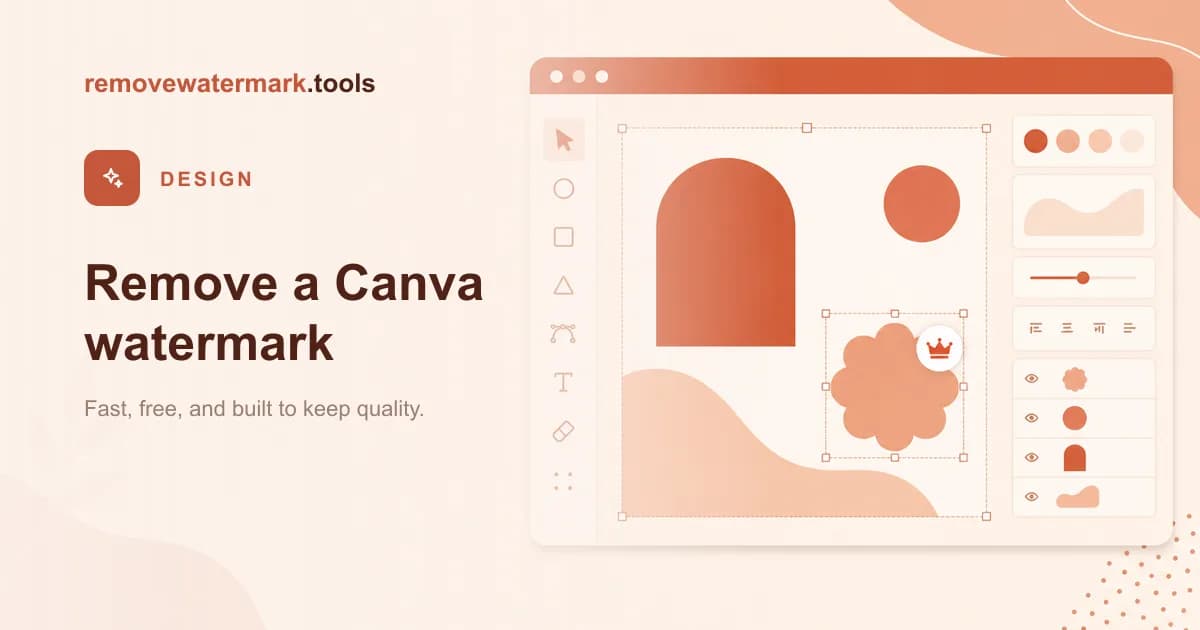
- Look for a small crown or diamond icon. Premium items show this badge when selected or in the layers panel.
- Check the export dialog. When you try to download, Canva lists how many premium elements are in use and often names them.
- Note every flagged item. A single paid photo is enough to watermark the whole page, so track down all of them.
Once you have the full list, you can decide how to clear each one.
Your three clean options
There is no honest shortcut here, but the fixes are simple. Pick whichever fits your budget and timeline.
| Option | Best when |
|---|---|
| Buy the single element | You only need one or two paid items for this one design. |
| Subscribe to Canva Pro | You use premium content often and want the full library unlocked. |
| Swap for a free element | You want zero cost and the design works fine with a free match. |
How to export clean by swapping elements
The free route is the one most people want, and it works well because Canva's free library is large.
- Select the flagged premium element you identified earlier.
- Search the free library for a similar item. Filter the elements or photos panel to free results.
- Drop the free version in and match its size and position to the original.
- Repeat for every premium item until no crown or diamond icons remain.
- Open the export dialog again. When the premium notice is gone, download the file.
Your exported image will now be clean, fully yours to use, and you paid nothing. If you would rather keep the exact premium item, buy it or start a Pro plan instead, then re-export the same way.
When an AI remover actually makes sense
There is one narrow case where a removal tool is the right call: you have a finished image you already own, the watermark is your own, and you can no longer re-export it from Canva. Maybe the original design is gone, or someone sent you a flat file and the editable version is lost.
In that situation, reconstructing a clean version with an AI watermark remover is reasonable, because the underlying content is yours. This is the same principle that applies to stock photos, covered in can I remove a watermark from an image I purchased: your right to the file is what matters, not the editing.
What a tool should never do is strip a Canva mark off premium content you have not bought, just to dodge the price. That is using paid work for free, and it is not allowed.
Stay within the rules
The line is simple. Clearing a Canva watermark by buying the element, getting Pro, or swapping in free content is completely fine, because you end up with content you are entitled to use. Stripping the mark off a preview to use unpurchased premium content is not, because the watermark is there precisely to protect the contributor who made it.
When in doubt, ask one question: do I have the right to use every element in this design? If yes, the clean export is one click away inside Canva. If no, buy it or replace it.
Final recommendation
For nearly everyone, the fix is not removal at all. Find the premium elements, then either pay for them or swap them for free alternatives, and let Canva hand you a clean export. Reach for an AI watermark remover only when you already own a finished image and have no way to re-export it. That keeps your work clean, legal, and yours.