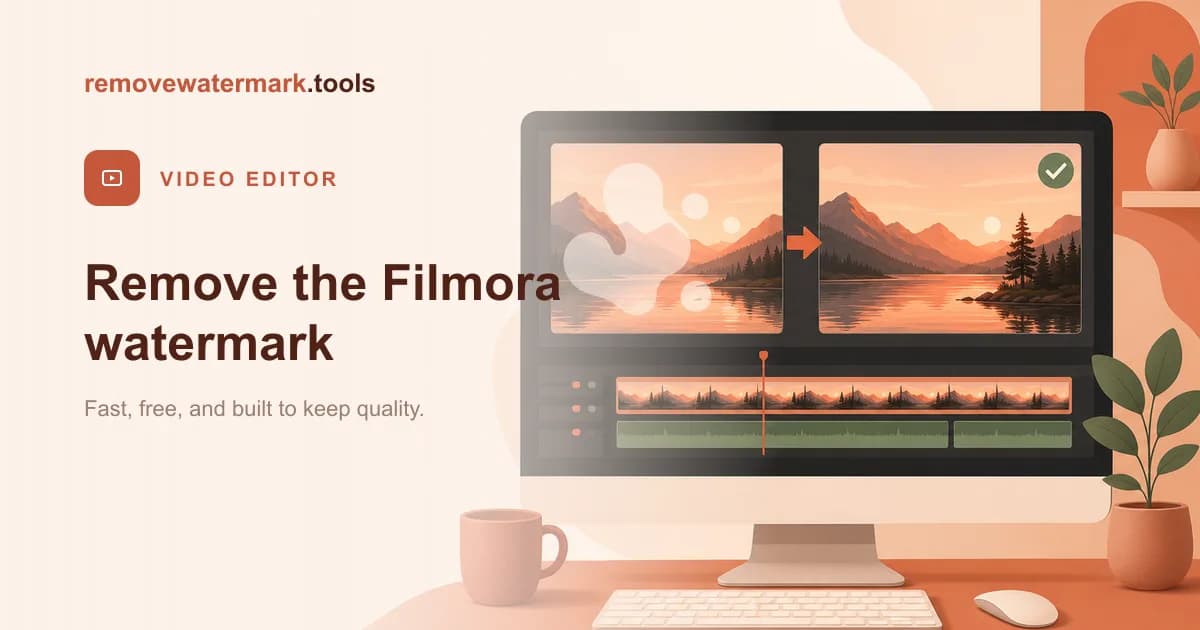
Quick answer: If you still have the Filmora project, the cleanest fix is to sign in to a licensed Filmora account and re-export. The watermark only appears on free-trial output. If you only have the finished file, drop it into our video watermark remover and the AI rebuilds the area behind the centred logo. Free for three videos a day, no signup. Only edit videos you made or are allowed to change.
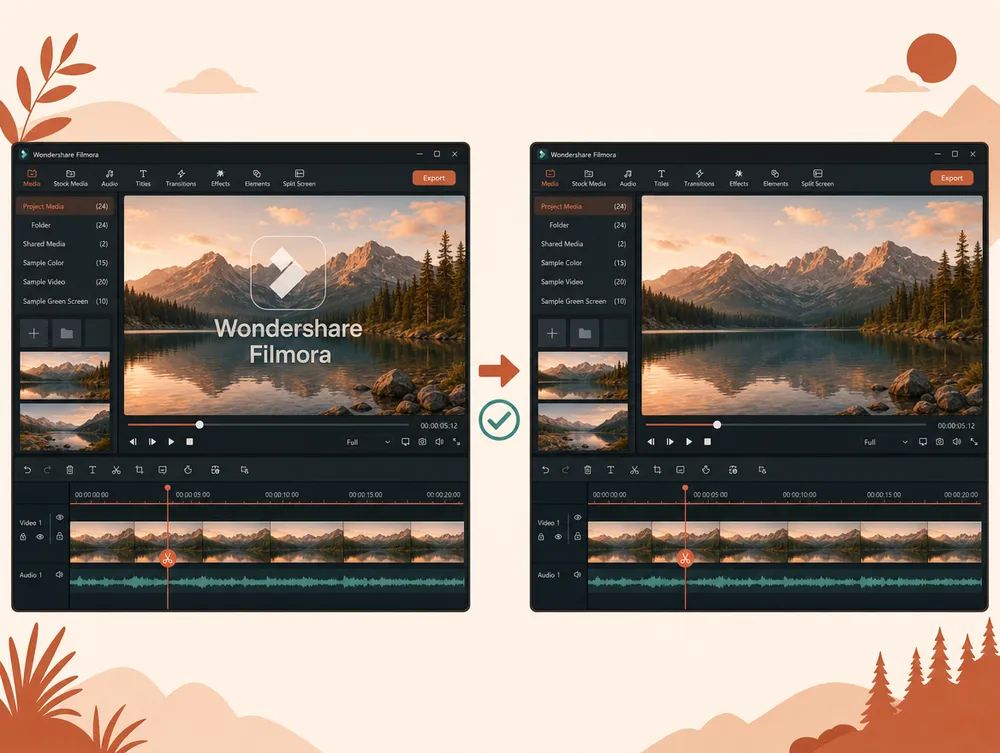
Wondershare Filmora places a translucent logo in the middle of every video exported without a paid licence. It sits over the busiest part of the frame, so a crop usually ruins the composition and a blur just trades one distraction for another.
There are two honest routes, and which one fits depends on what you are holding: the editable project, or only the finished video.
Route 1: re-export from a licensed account (the cleanest result)
The Filmora watermark is not burned into your footage while you edit. It is added at export time on the free plan. That means the original, watermark-free frames still exist inside the project.
If you have the .wfp project file:
- Open the project in Filmora on the same machine where you built it.
- Sign in to a licensed account. A paid Filmora plan removes the export watermark.
- Re-export the timeline. Match your original resolution and frame rate.
The output is pixel-perfect because nothing was ever covered. No AI, no reconstruction. When the project is available, this beats every other method.
The catch: it only works if you still have the project and are willing to license Filmora. If the project is gone, or you were sent the finished clip by someone else, Route 2 is your option.
Route 2: rebuild the frame with AI (when you only have the file)
When the watermarked video is all you have, an AI inpainting tool reconstructs the pixels behind the logo from the surrounding frames. The Filmora mark is static and centred, which is a favourable case: the background behind it usually drifts enough across the clip for the AI to borrow clean detail.
This is the same flow as our general video watermark guide, tuned to where Filmora puts its mark.
Walkthrough
- Open the tool. Go to the video watermark remover. The first three videos each day are free, no signup.
- Upload the export. Drop your MP4 or MOV, up to 500 MB.
- Confirm the area. Auto-detection finds the standard centred logo. If your export carried a corner mark or an end-card, brush over it manually.
- Run the cleanup. The AI works frame by frame and keeps the audio bit-identical.
- Download. The output matches your source codec and resolution.
Pro tip: Use the highest-quality copy of the export you have. A re-uploaded or screen-recorded version has softer logo edges, which makes detection less precise and the patch less clean.
Where does the Filmora watermark sit?
Knowing the placement sets expectations before you start.
- Standard export: a semi-transparent Wondershare Filmora wordmark in the centre of the frame.
- Some templates: an additional intro or end-card with the logo on a plain background, which is the easiest case of all to clear.
- Older versions: a smaller corner mark instead of the centred one.
A centred logo over a calm background cleans up almost invisibly. A centred logo over a face or fast motion is the hardest case, because no nearby frame fully reveals what belongs underneath.
Re-export vs. AI removal: which should you use?
| Re-export with a licence | AI removal from the file | |
|---|---|---|
| You need | The Filmora project plus a paid licence. | Only the finished watermarked video. |
| Result quality | Perfect. Nothing is reconstructed. | Usually clean; a soft patch is possible over detail. |
| Cost | A Filmora subscription or perpetual licence. | Free for three videos a day. |
| Best when | You still own the editable project. | The project is gone or the clip came from someone else. |
Will removing the watermark reduce quality?
With Route 1, no. The frame was never covered, so a licensed re-export is identical to any other export.
With Route 2, the patched centre is a reconstruction. Over a steady background you will rarely spot it. Over a face or fine motion, a soft patch can show. The rest of the frame keeps its native resolution and the audio is preserved bit-identical. You should not expect flawless recovery on every clip.
Stay within the rules
Only clear the Filmora watermark from a video you made yourself, or one you have been given permission to edit. Your own exports are entirely fair game; the watermark is just the free plan's reminder to upgrade.
Removing the mark from someone else's video to reuse or reupload it as your own can breach copyright and platform rules. The tool is for finishing your own work, not for taking credit for others'.
Final recommendation
If you still have the project, license Filmora and re-export. It is the only route with zero reconstruction, and the result is flawless.
If the project is gone and you only have the file, drop it into the video watermark remover. For another editor's mark, the same approach works for the CapCut watermark and other in-app logos.